
As a Center for Independent Living, RAMP offers a range of services to disabled members of our communities to help them lead independent lives. This can look like finding job opportunities for people who want to work, educating students about their disabilities, or advocating for people whose rights are being violated.
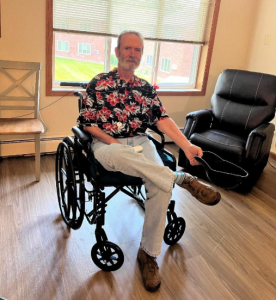
Community Reintegration consumer Stephen enjoys his new apartment and his independence.
Another key service we provide is community integration. Through education and assistance, RAMP helps people with disabilities receive care and services in their own homes rather than residential institutions like nursing homes. This allows people with disabilities to leave institutional settings to find their own homes and communities, or to remain in their homes and communities if their needs change.
This frees up space in residential institutions for people who need it most, while giving independence to people who want to live on their own. For the fiscally concerned, this also saves the government quite a bit of money. The average cost of a semi-private room in a nursing home is over $111,000 a year, while community-based support is only $36,000. Through community integration, RAMP saves taxpayer dollars and helps people with disabilities lead independent lives without being institutionalized.
History
Those who know disability history know this has not always been an option for people with disabilities. Laws like the Rehabilitation Act of 1973 and the Americans with Disabilities Act (ADA), passed in 1990, are younger than many of the people they protect. Before such laws existed, people with disabilities were often sequestered from their communities, kept in grim institutions separate from public life, out of sight, out of mind.
At their worst, these facilities were unwilling or unable to provide even the minimum care their patients needed. Many were rife with abuse and neglect that went unnoticed precisely because they were so far out of the public eye.
But even functioning at their best, these institutions required people with disabilities to leave their homes and communities to receive the care they needed. Through Medicaid and Medicare, people with disabilities could receive the care they needed to live, but with the catch of segregation and isolation from their communities.

President George H.W. Bush signing the ADA into law on July 26, 1990.
Olmstead
In the late ‘90s, a lawsuit challenged the idea that government care could cost disabled people’s freedom. Two women with mental and developmental disabilities were voluntarily admitted to a psychiatric unit of a state-run hospital. After receiving treatment, they were cleared by mental health professionals to leave the institution and move to a community-based program. When the hospital kept them institutionalized against their wishes and their doctors’ advice, they sued to be released.
The Olmstead case reached the Supreme Court in 1999, where it was decided that this was unjustified segregation under Title II of the ADA. The court held that public entities like state and local governments must provide community-based services when appropriate, not opposed by the recipient of services, and able to be reasonably accommodated.
In other words, if the government could feasibly provide a desired service in a community-based setting rather than an institutionalized one, it had to.
Two and a half decades after the decision, Olmstead’s impact can be seen in communities across America. When the decision was issued in 1999, nearly three quarters of all Medicaid long-term services and supports (LTSS) spending went to institutions, with 27 percent going to home and community-based services (HCBS). By 2020, the balance had shifted dramatically. Institutional services fell to 38 percent of Medicaid LTSS spending, with 63 percent now going to HCBS. This shift allowed an estimated 80 percent of people living in institutions in 1987 to move to community-based settings by 2019.
RAMP’s Perspective
Of course, this success is reflected by more than just statistics and figures. As a Center for Independent Living, RAMP has witnessed firsthand how community integration has evolved alongside policy changes made in the wake of Olmstead.
Jane Hendrickson, RAMP’s Independent Living Services Manager, says that community integration is vital to “help the individual live in their community, stay involved in their church, take part in service groups they enjoy, pursue their hobbies, and shop locally for everyday needs, supporting the local economy.”
As the leader of RAMP’s Community Reintegration Transition Program, Traumatic Brain Injury Program, and Personal Assistant Program, Jane has guided countless consumers through transitions from nursing homes or facilities back into homes of their own in her over 16-year tenure at RAMP. In this time, she has seen plenty of changes to community integration.
Originally, the Community Reintegration Transition program was limited to individuals with physical disabilities aged 18 to 60, unless they had a traumatic brain injury or HIV and qualified under those specific waivers. Individuals with mental health conditions or developmental delays were not eligible at that time.
As of July 1, 2019, the program expanded to serve individuals of any age and with all diagnoses, including mental health conditions, provided a safe and appropriate service plan can be established.
Personal Stories
Many of the people Jane and other RAMP staffers have assisted are thrilled to share their stories, like Robyn, who called RAMP “a definite life-changer.”
After spending more than a year in a nursing home, another resident informed Robyn of RAMP’s Community Reintegration Program. RAMP staff helped her apply for housing and in-home services. Today, Robyn has her own apartment where she enjoys spending time with family and living independently.
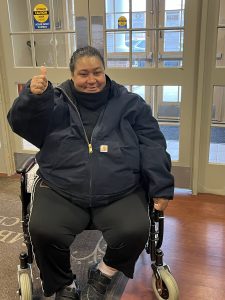
Community reintegration consumer excited to move into her new home!
Loren is another RAMP consumer who found himself in a nursing home, when an unexpected medical condition made it necessary for him to stay in a nursing home for rehab. This meant he was separated from Lewis, his pet finch. After four months in the nursing home, RAMP and Loren worked together to find an apartment, where Loren was reunited with Lewis. Today, Loren keeps busy by going on walks, fishing in the Rock River, and spending time with friends, family, and finches like Clark, Loren’s new friend for Lewis.
RAMP has also helped people keep their homes, not just find new ones. When Pat reached out to RAMP in 2024, she was having trouble staying in her home, as her disabilities were making her stairs too difficult to navigate. Rather than giving up her home, RAMP was able to help Pat get a stairlift, making her home accessible again.
The lion’s share of the credit for these success stories is due to the hard work and dedication of the individuals and the RAMP staff that helped them reach their goals. Still, it’s unpleasant to imagine where they’d be if not for the Olmstead decision, which made community integration the law of the land.
It’s also worrying to imagine what would happen if the protections for people with disabilities to receive community-based care were to go away.
Looming Threats
It goes without saying that the fight for disability equality is far from over, as progress is, and will always be, a work in progress. But today, some changes and challenges are making community integration harder, rather than easier, for people to achieve.
The current administration has implemented changes that threaten decades of disability rights like Olmstead. Last year, President Trump issued an executive order called “Ending Crime and Disorder on America’s Streets,” purportedly to “restore public order.”
Though it claimed to be a “new approach” to public safety, the text of the order called for “the reversal of Federal or State judicial precedents and the termination of consent decrees” that prevent the institutionalization of people with mental illness, including the homeless, against their will. The executive order called for people with mental illness, a protected disability, to be placed in institutions if they were deemed unable to care for themselves, with no definition of how that would be determined and no input from the people affected.
This came with the now common threat of withheld funding for states that didn’t comply. But it also posed a direct challenge to the Olmstead decision, which found that unjustified institutionalization of people with mental disabilities is unlawful discrimination.
As an executive order, this is not a law, and it isn’t currently being reviewed by the Supreme Court. But it is the subject of litigation in lower courts, and if it reaches the Supreme Court, there is a real risk that Olmstead gets overturned. If that happens, and Congress doesn’t codify the right of people like Robyn, Loren and Pat to receive care in their own homes, decades of progress would be undone. People with disabilities could be needlessly forced back into institutional settings, potentially overwhelming facilities that cost far more tax dollars than community-based services.
Community reintegration is a fundamental civil right. But like many rights, it is the result of an ongoing fight that is clearly far from over. Now more than ever, it’s crucial that advocates defend the right of people with disabilities to receive care in their communities.
If you or anyone you know wishes to leave or avoid an institutional care facility, please contact RAMP. Our staff are here to provide community integration services to anyone with a disability in Winnebago, DeKalb, Stephenson, and Boone counties.
Help us support others who want to gain back their independence – donate to RAMP.